

Energy Dashboard
Your one-stop shop for monitoring mining and energy operations in real time. The Luxor Energy Dashboard centralizes all operational, financial, and contractual data into a single platform.
The dashboard is divided into three components:
- Real Time conditions - Monitor load, pricing, obligation, and profitability as they happen.
- Earnings & Programs - Track daily and cumulative earnings from mining and demand response.
- Contracts - Manage your energy contracts and integrate them into revenue and cost calculations.
Real Time Conditions
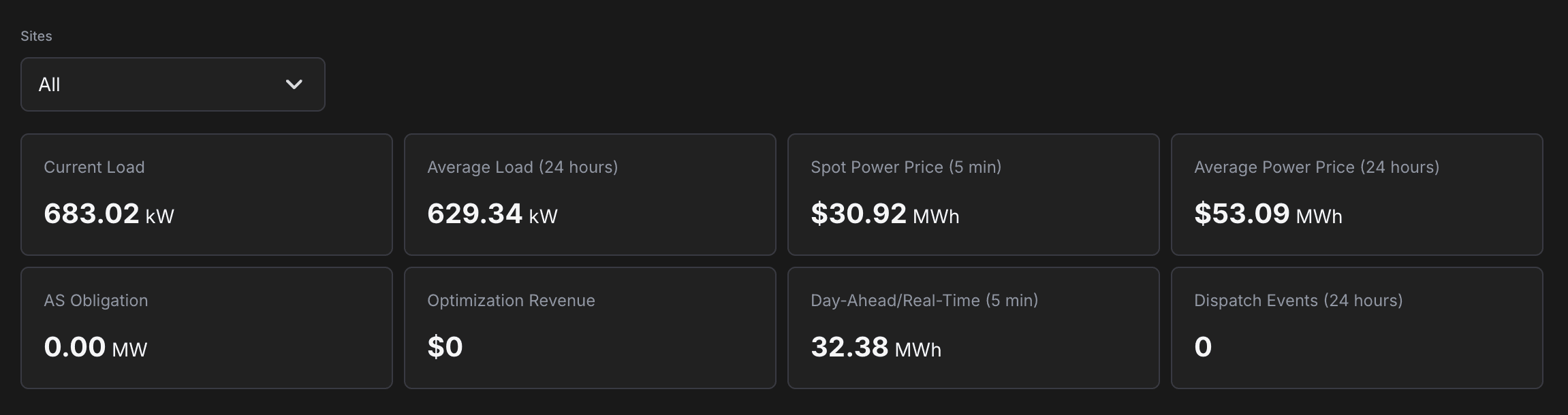
The Real Time Conditions dashboard provides live operational insights across any or all of your mining sites. Key metrics include:
- Current and 24h average mining load (MW)
- 5-minute spot and day-ahead power prices
- 24h average power price
- Ancillary Service (AS) obligations
- Optimization revenue
- Dispatch events over the last 24h
Visualizations
Two customizable views allow you to see both operations and profitability.
Operations View
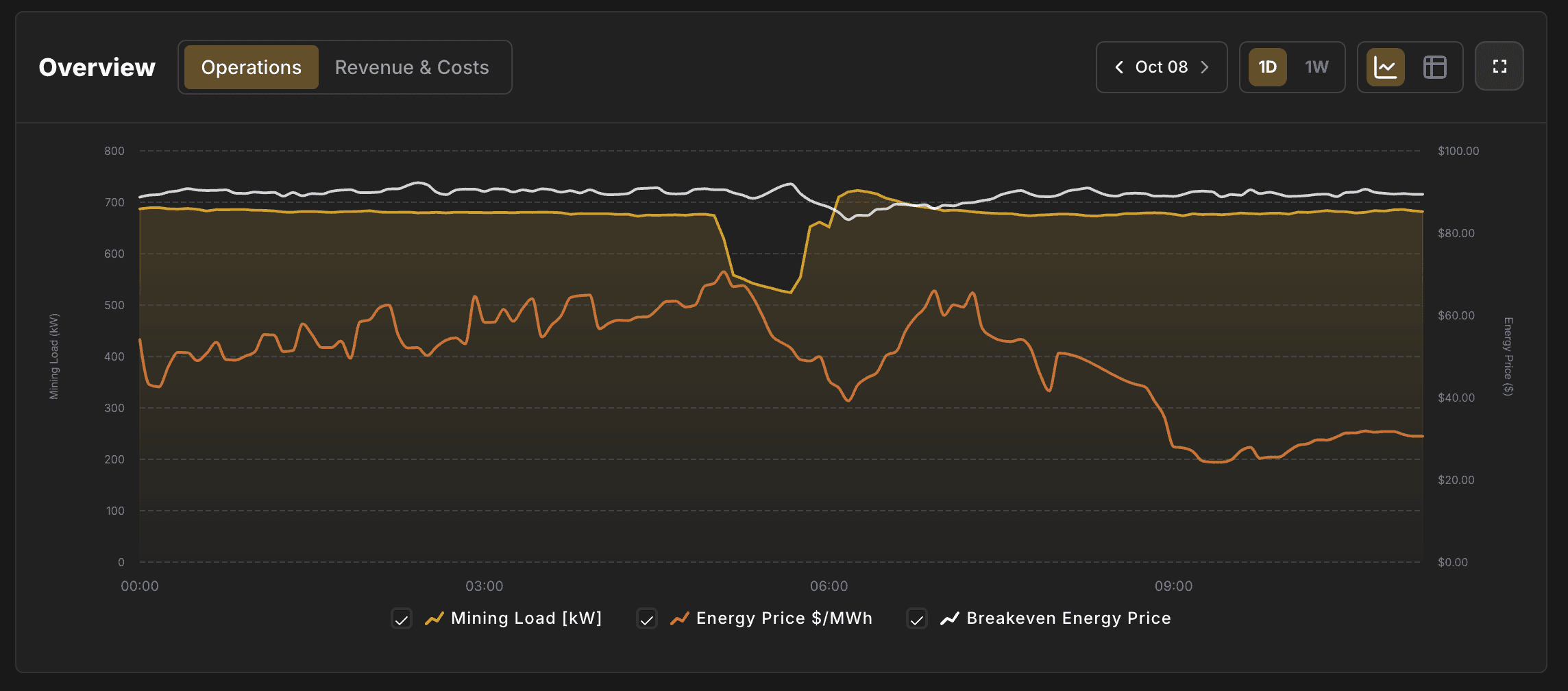
- Mining load vs. energy price over selectable time periods (last day, last week, or custom).
- Orange line = energy price, yellow line = mining load, white line = breakeven energy price.
- Table format available with MW usage and energy price by interval.
Revenue & Costs View
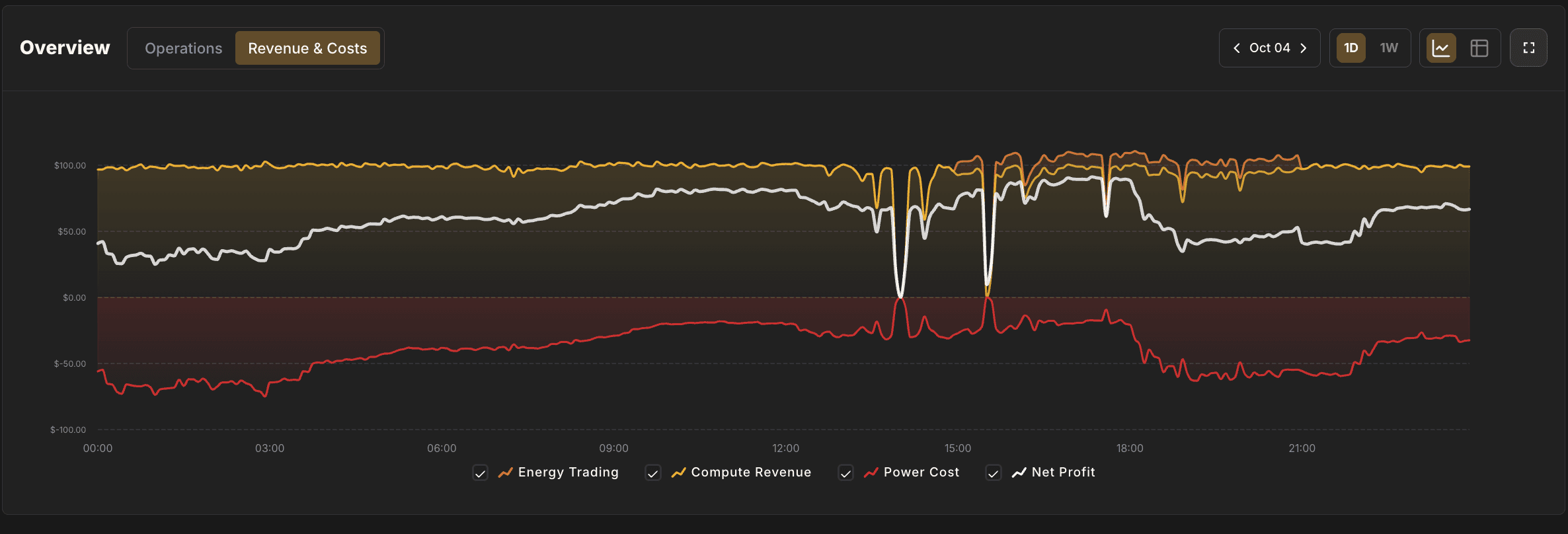
- Tracks compute revenue, energy trading, power cost, and net profit in real time.
- Compute revenue pulls directly from your Luxor Mining Pool subaccounts.
- Energy trading revenue reflects DR and optimization programs.
- Full table export available.
Earnings and Programs
The Earnings & Programs dashboard gives a higher-level view of both mining and energy market performance.
 Key Metrics
- Total revenue
- Average daily revenue
- Total DR program revenue
- Average revenue MW (over last 30 days or custom period)
Visualizations
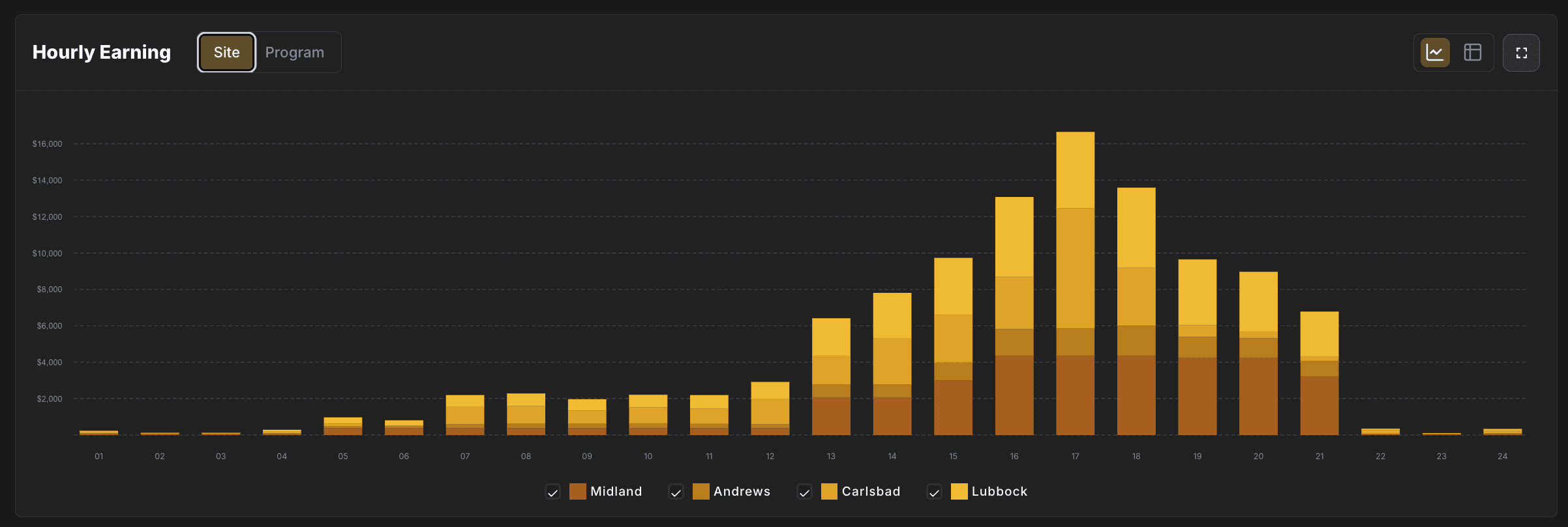
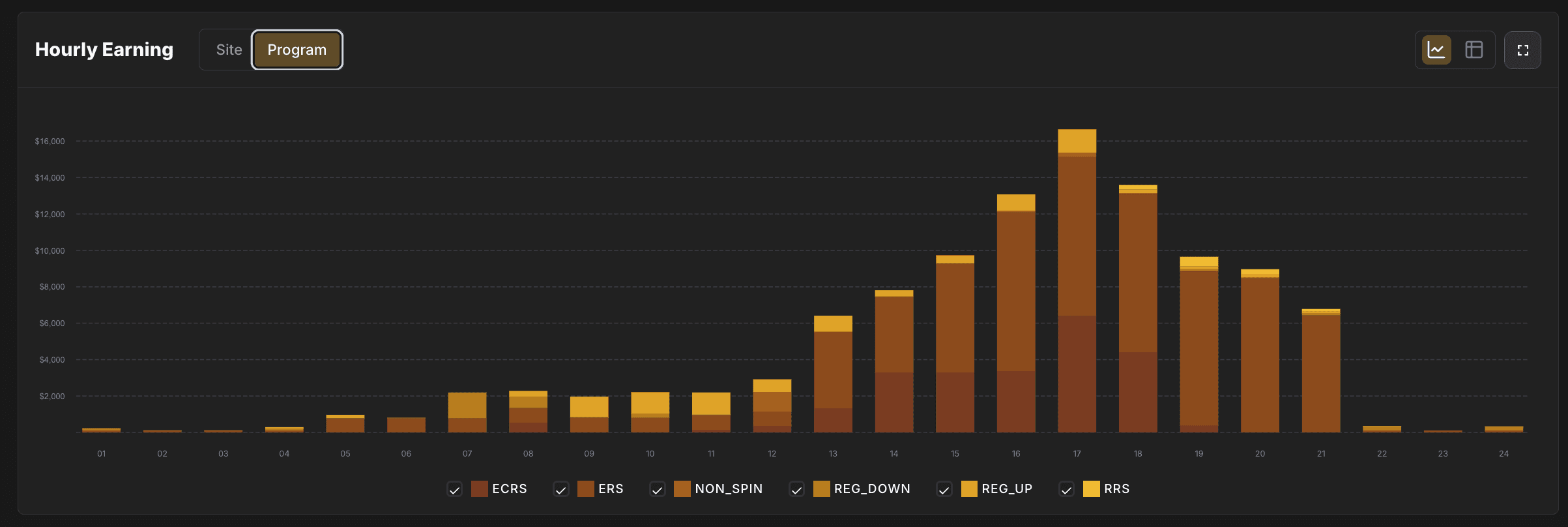
- Average Hourly Earnings: Mining + AS revenue, broken down by site and DR program participation (exportable as CSV).
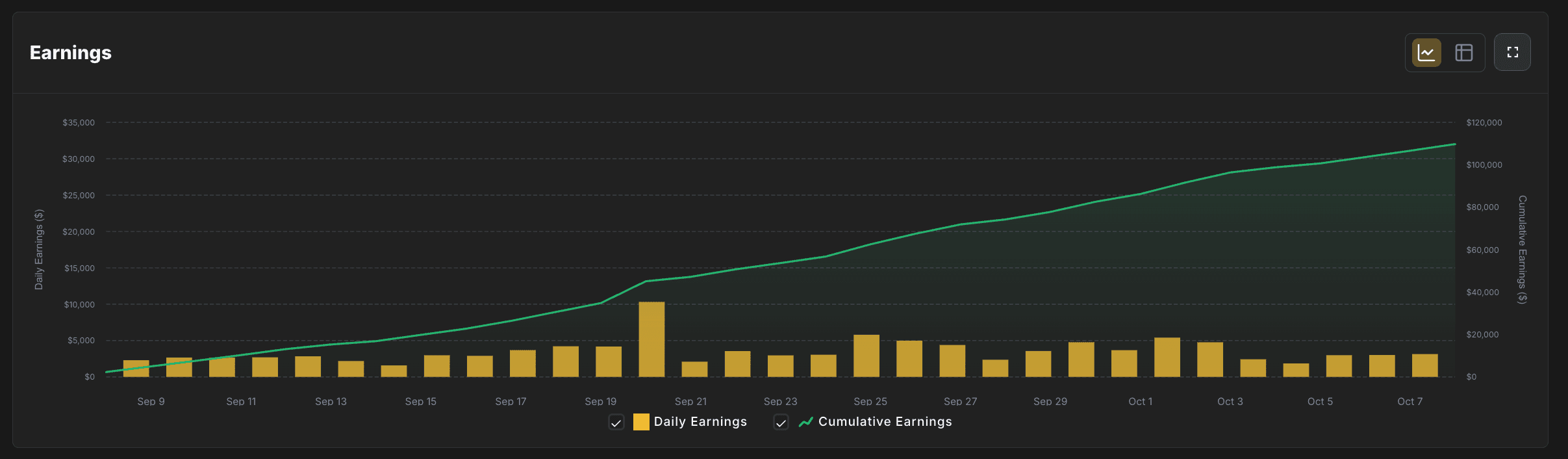
- Earnings by Day: Daily + cumulative earnings across the selected time period (exportable as CSV).
Dispatch Events
A table of all dispatch events tied to your DR program participation, helping you reconcile earnings against obligations.
Contracts
The Contracts tab allows you to input and manage energy related agreements.
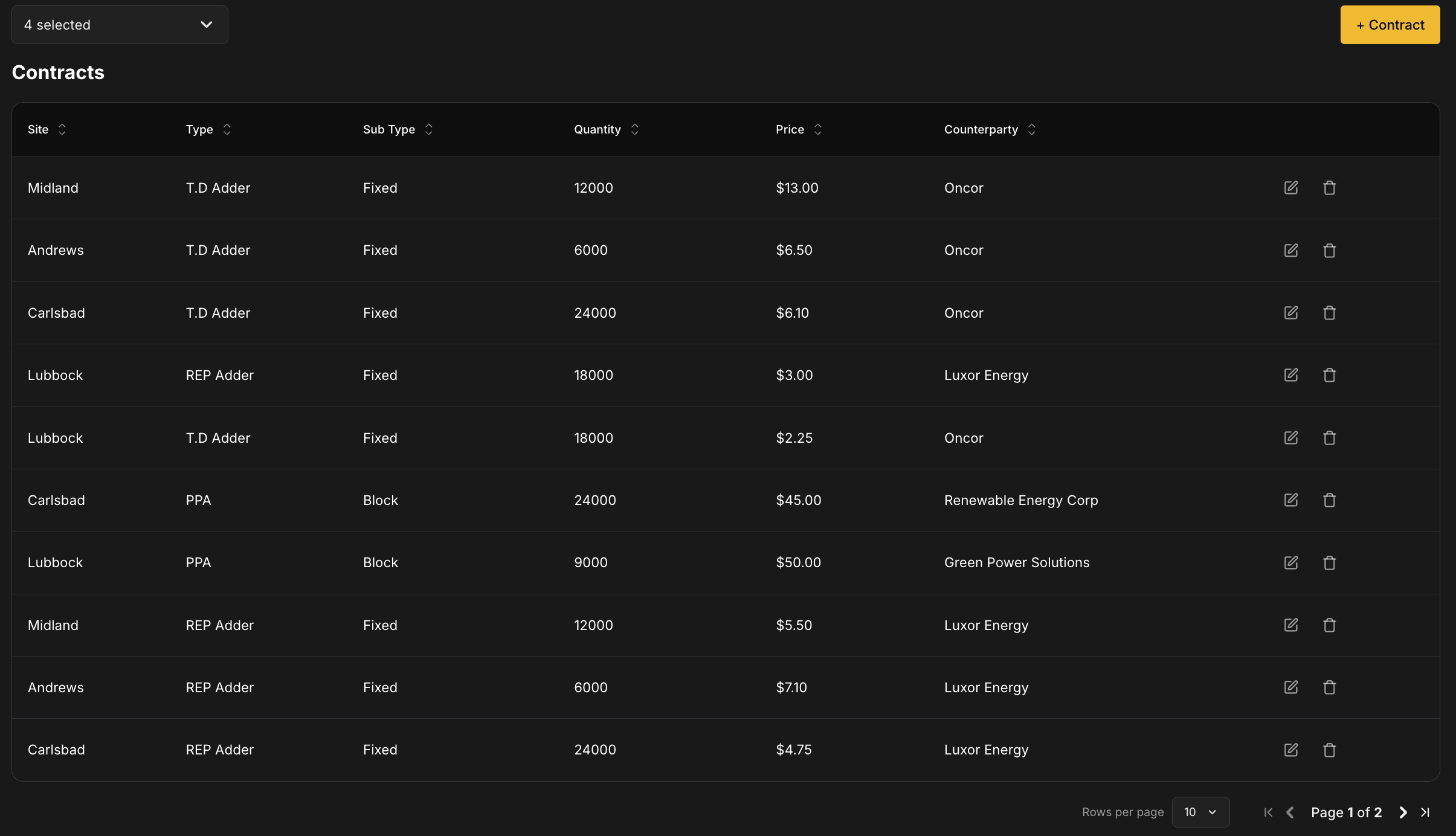
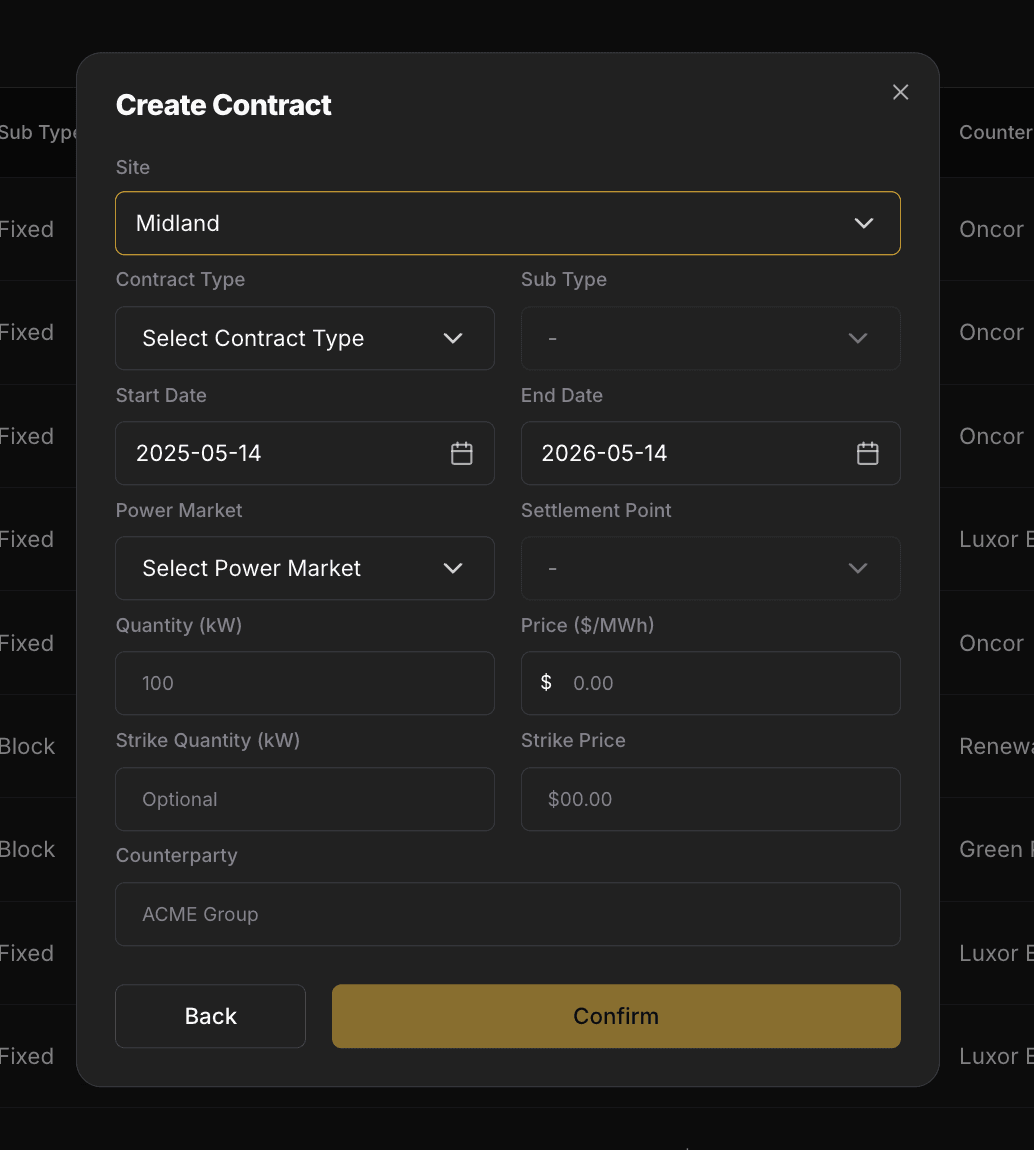
All contracts are fully customizable. Once entered, contract terms are automatically incorporated into:
- Real-time power cost calculations
- Net profit calculations
- Energy-Adjusted Hashprice metrics
- Historical earnings and forecasting views
Our currently supported contract types include:
Day Ahead
A Day Ahead contract reflects energy purchased in the day-ahead market, where power prices are locked in 24 hours before delivery.
How it feeds into calculations:
- The committed volume is priced at the day-ahead rate.
- Any over- or under-consumption is settled against real-time prices.
- These values are reflected in the Power Cost line of the Revenue & Costs view.
Options
An Energy Option is a financial contract that gives the holder the right — but not the obligation — to transact power at a predetermined strike price.
Options can be structured in two ways:
- Long Option – You pay a premium for the right to buy (or sell) power at a strike price.
- Short Option – You collect a premium in exchange for giving another party the right to transact power at a strike price.
| Position | Call | Put |
|---|---|---|
| Long | The user pays a premium for the right to buy power at a given strike price. | The user pays a premium for the right to sell power at a given strike price. |
| Short | The user collects a premium for the obligation to sell power at a given strike price. | The user collects a premium for the obligation to buy power at a given strike price. |
In practice, miners are typically long optionality. A miner can monetize this by selling a call option.
How it works for miners (Short Option):
- The miner collects a premium upfront.
- If real-time prices rise above the strike price, the miner cannot sell power above that strike.
- The miner effectively caps upside exposure in exchange for guaranteed premium income.
How it feeds into calculations:
- Collected premiums are included as revenue.
- If the option is exercised, realized power pricing is capped at the strike price.
Options are typically used by miners to monetize volatility and generate additional yield on flexible load.
PPA (Power Purchase Agreement)
A Power Purchase Agreement (PPA) is a longer-term agreement to procure electricity at defined pricing terms. Luxor Energy supports both Block PPAs and Fixed PPAs, which differ materially in how they interact with real-time markets.
Block PPA
A Block PPA is a fixed-volume contract that delivers a defined amount of power (MW) to your settlement point at a fixed price.
How it works:
- You contract a fixed MW block at a fixed price.
- You are financially settled at the real-time market price for that volume.
- If real-time prices exceed your fixed price, you receive the difference.
- If real-time prices fall below your fixed price, you pay the difference.
This structure allows miners to effectively “sell” power back into the market when not consuming it.
Block PPAs are similar to Day-Ahead positions, but:
- They apply over longer-term horizons.
- They typically apply across all hours of the contract period.
How it feeds into calculations:
- The fixed contract price is modeled as your energy cost.
- Real-time price deviations are settled against that fixed rate.
- Net exposure is reflected in Power Cost and Revenue & Costs views.
Block PPAs provide structured exposure to real-time volatility while maintaining long-term price certainty.
Fixed PPA
A Fixed PPA locks in a flat price for power consumption with no linkage to real-time market prices.
How it works:
- You consume power at the fixed contract rate.
- There is no settlement against real-time pricing.
- If market prices spike or fall, your cost remains unchanged.
How it feeds into calculations:
- The fixed rate becomes your energy price input.
- Power Cost is stable and predictable across the contract duration.
Fixed PPAs provide maximum cost certainty but eliminate participation in real-time market upside.
Retail (REP) Adders
REP Adders represent the service fee charged by a Retail Electric Provider on top of wholesale energy pricing.
How it feeds into calculations:
- REP adders are layered on top of the underlying energy price (day-ahead, real-time, or PPA).
- They are included in the total Power Cost calculation.
- This ensures your dashboard reflects true delivered energy cost, not just wholesale price.
Transmission & Distribution (T&D) Adders
T&D Adders represent charges associated with delivering electricity through transmission and local distribution infrastructure.
How it feeds into calculations:
- T&D charges are added to your total energy cost per MWh.
- They apply regardless of energy procurement method (day-ahead, PPA, etc.).
- Many T&D charges are billed on peak demand (not MWh). These calculations are reflected for REP customers only.
How Contracts Impact Profitability Metrics
All contracts entered in the Contracts tab automatically influence:
- Power Cost (Revenue & Costs view)
- Net Profit (Compute + Energy Trading – Total Power Cost)
- Breakeven Energy Price (Operations view white line)
- Energy-Adjusted Hashprice
- Historical and forward-looking profitability analysis
By modeling contracts directly inside the platform, Luxor Energy gives miners a complete view of how procurement strategy impacts mining revenue and overall operational margins.